
A special thank you to everyone who participated in this project!
This website was created following Occupational Approaches For Reducing Food Insecurity project (Sabbara, 2021). This project started with a mixed methods research study which included the United States Adult Food Security Survey Module, a sociodemographic survey and a qualitative interview. This research study was conducted with 5 college students from a rural community college in California. Additionally a needs assessment was conducted with 9 other California colleges and universities, as well as 3 basic needs organizations. The F.U.E.L website was created to address the needs expressed by college students and professionals to enhance food security.
The graphs and tables below detail the findings of the Occupational Approaches For Reducing Food Insecurity study and needs assessment.
Figure 1
Food Security Status
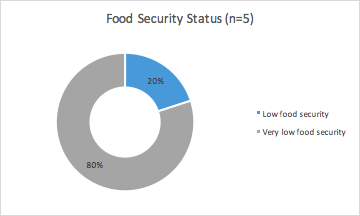
Figure 2
Participant Annual Income
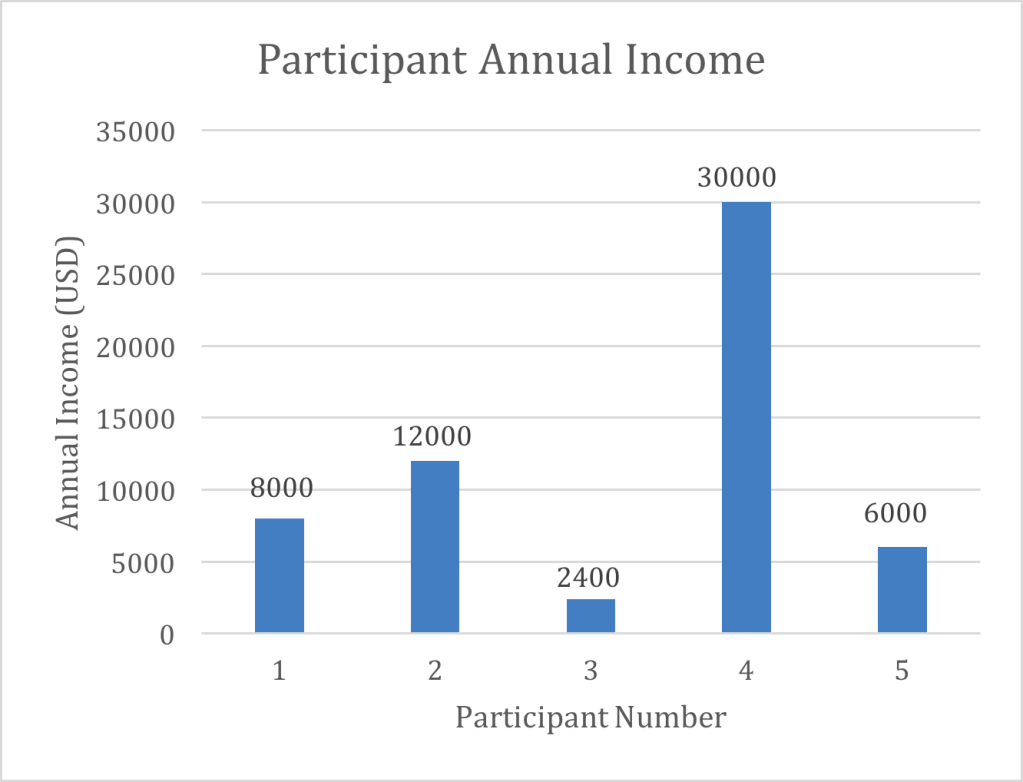
Table 1
United States Adult Food Security Survey Module Affirmative Responses
| Questions | Affirmative Responses per Participant | ||||
| Participant 1 | Participant 2 | Participant 3 | Participant 4 | Participant 5 | |
| Which of these statements best describes the food eaten in your household in the last 12 months? | n/a | Sometimes not enough to eat | n/a | n/a | Sometimes not enough to eat |
| “(I/We) worried whether (my/our) food would run out before (I/we) got money to buy more.” Was that often true, sometimes true, or never true for (you/your household) in the last 12 months? | Sometimes true | Sometimes true | Sometimes true | Sometimes true | Often true |
| “The food that (I/we) bought just didn’t last, and (I/we) didn’t have money to get more.” Was that often, sometimes, or never true for (you/your household) in the last 12 months? | Sometimes true | Sometimes true | Sometimes true | Sometimes true | Often true |
| “(I/we) couldn’t afford to eat balanced meals.” Was that often, sometimes, or never true for (you/your household) in the last 12 months? | Often true | Sometimes true | Sometimes true | Sometimes true | Sometimes true |
| In the last 12 months, since last March, did (you/you or other adults in your household) ever cut the size of your meals or skip meals because there wasn’t enough money for food? | n/a | n/a | n/a | Yes | Yes |
| (If you answered yes to question #6) How often did this happen? | n/a | n/a | n/a | Some months, but not every month | Almost every month |
| In the last 12 months, did you ever eat less than you felt you should because there wasn’t enough money for food? | Yes | Yes | Yes | Yes | Yes |
| In the last 12 months, were you ever hungry but didn’t eat because there wasn’t enough money for food? | Yes | Yes | n/a | Yes | Yes |
| In the last 12 months, did you lose weight because there wasn’t enough money for food? | Yes | n/a | n/a | n/a | n/a |
| In the last 12 months, did (you/you or other adults in your household) ever not eat for a whole day because there wasn’t enough money for food? | n/a | n/a | n/a | n/a | Yes |
| (If you answered yes to question #10) How often did this happen? | n/a | n/a | n/a | n/a | Almost every month |
| Total Affirmative Responses | 6 | 6 | 4 | 7 | 10 |
Table 2
College Programming Needs
| Needs Assessment Participant | Financial Literacy Needs | Nutrition/Food Literacy Needs | CalFresh/Food resource Needs | System/External Needs |
| Community College 1a | -Financial literacy workshops (or required finance courses) | -Food literacy workshop -More incentives for cooking/nutrition education (i.e. cook and eat a meal together) -Healthy eating flyer | -Dedicated Calfresh representative -More than one pantry -More access to pantry -CalFresh education on how it works | -Increase awareness and buy-in on campus and in community -Decrease stigma -Promote services -More visibility |
| Community College 1b | Financial aid workshops (currently available to students) | Cooking demonstrations, tutorials and recipes | -How CalFresh works -Connection to resources | -More collaboration with outside organizations -Expand network to other outside organizations (FI, housing) -Students’ rights -Reduce stigma -Self advocacy -Teaching students to navigate system/services -More staff, continued support and funding -Consolidate resources “one stop shop” |
| CSU 1 (2 people) | Continue to offer money management center | -Continue CalFresh Healthy Living programming (cooking classes) -Continue to provide recipe cards and live cooking demonstrations -Sustain cooking program after grant ends -Incorporate registered dietitian (currently very in-demand on campus) | -Workshops in gardening -Education on CalFresh | -More outreach through faculty and staff -Continue basic needs ambassador training program -More marketing about app -More marketing to various departments |
| CSU 2 | Encourage/support for current peer financial literacy program and financial aid support | -Cooking skills demonstrations -Creating recipes -Recipe videos -More nutrition education -How to make food stretch/combine foods in different ways. | -More CalFresh Healthy Living programming -Increase Calfresh screening | -More outreach and virtual drop in basic needs services -Set dedicated times for EOP student drop-ins -Collaboration with veterans, pride and other campus centers -More advocacy for students and connection to resources -More follow up with students (staff permitting). |
| CSU 3 | – “Necessary vs nice”=prioritization tools -Expand loan and financial aid education, including financial planning and literacy programming -Budgeting resources -Preventative and long-term financial education -Continue financial literacy series | -Shopping in season -College cooking hacks -Food budgeting -Reframing the costs of groceries versus eating out -Revive pre-COVID programs, including on-campus food pantry/food resources -Continue online cooking demos, grocery gift cards, and cooking material raffles -Establish permeant food pantry. | -Reduce barriers to Calfresh -Improve student eligibility and reduce paperwork burden | -Write to a representative (event or program) -More information and guidance on resources -More funding for emergency support programs |
| CSU 4a | -Shopping tips “Bang for your buck” -Continue financial literacy course | More food literacy programming and programming beyond provision -More recipes -More information about nutritious food and knowledge about food. | More CalFresh Healthy Living programming | -Housing and rental assistance -Increase collaboration with community partners |
| CSU 4b | Financial education (Loan debt v.s. credit card debt) | -Understanding what food security means -How to access nutritional, affordable, and easy to store food. -How to use and store food with available resources -Continue nutrition, food access workshops on campus | -Reduce barriers to CalFresh enrollment -Continue CalFresh Healthy Living | -Make sure that resources are easy to search for online -Change narrative about basic needs security (accessible, available and more universal on campus) -Reduce stigma -Add low cost or no cost meal programs for colleges -Integrate basic needs services in the advertised cost of higher education -Include basic needs service in financial aid package/information -Expand Pell Grants -More loan forgiveness opportunities -Train staff in trauma-informed approach |
| UC 1 | n/a | -Food literacy -How to use food items they receive from the pantry -More specialty items for cultural or dietary preferences | -Increase CalFresh enrollment for long term food provision | -Less stigma and more understanding on from students and staff -Increase connection to students and volunteers |
| UC 2a | Continue to grow financial literacy programs | -Life skills training in high school or college | -Integrate CalFresh with Pantry so students can apply or talk to someone whenever the pantry is open. -More information about EBT accepting grocery stores on campus | -Dedicated Basic Needs Staff and more cross-collaboration -Sharing information throughout campus -A direct line to the county and more support on a community level for students off campus, students who are not currently enrolled and community members -More emphasis on empathy and collaboration among students and staff |
| UC 2b | -Provide more gift cards -Create a financial literacy seminar course | -Include more cooking when course is in-person again -Eating on a budget -Expand current courses and programming related to food. | n/a | -Make resources that are accessible for vulnerable populations (racial/ethnic minorities, first generation students, low income students) |
| UC 2c | -Create a financial literacy seminar course | -Better awareness and accessibility to food pantry and seminar classes (more central/accessible location) -Expand current courses and programming related to food. | n/a | -Financial support to sustain program -More cohesion and expansion of basic needs support programs -Address time poverty barrier and system navigation issues |
| FI/FS Organization 1 (Food Bank) | n/a | Food literacy education -Dorm room cooking -“Shopping Matters” education -Teach students how to use online benefits -Include more shopping challenges -Healthy take out food -More awareness of Cooking Matters program -How to cook with the ingredients they already have -Food safety/preservation | -Access to culturally appropriate and dietary appropriate foods | -Food and nutrition policy/advocacy -Reducing food waste -Partnerships with community organizations/local farms -Innovating food use (using old bread to make vodka) |
| FI/FS Organization 2 (National Food Literacy Program) | n/a | -More exposure to fruits and vegetables (for children, emerging adults and families) -Nutrition information -Food swaps -How to prepare non-traditional produce –Provide nutrition handbooks, tip cards, recipes, kitchen safety tips, and smarter snaking. -Transition program to grocery store so participants can buy the produce for themselves | n/a | -Increase funding, kitchen tools available, and time for programming. |
| FI/FS Organization 3 (National Basic Needs Organization | n/a | -More intentional provision to students -Teach students how to use items they receive from pantries or other resources -Provide cooking utensils -Provide cooking classes | -Support the expansion of SNAP and other financial stimulus (CARES act, COVID relief and emergency aid) | -Create a better community and social context for students -Improve awareness of the needs of college students at the college administration and community level |
If you are interested in learning more please contact Jessica Sabbara at jsabbara@fuelfoodsecurity.com
References

 F.U.E.L